

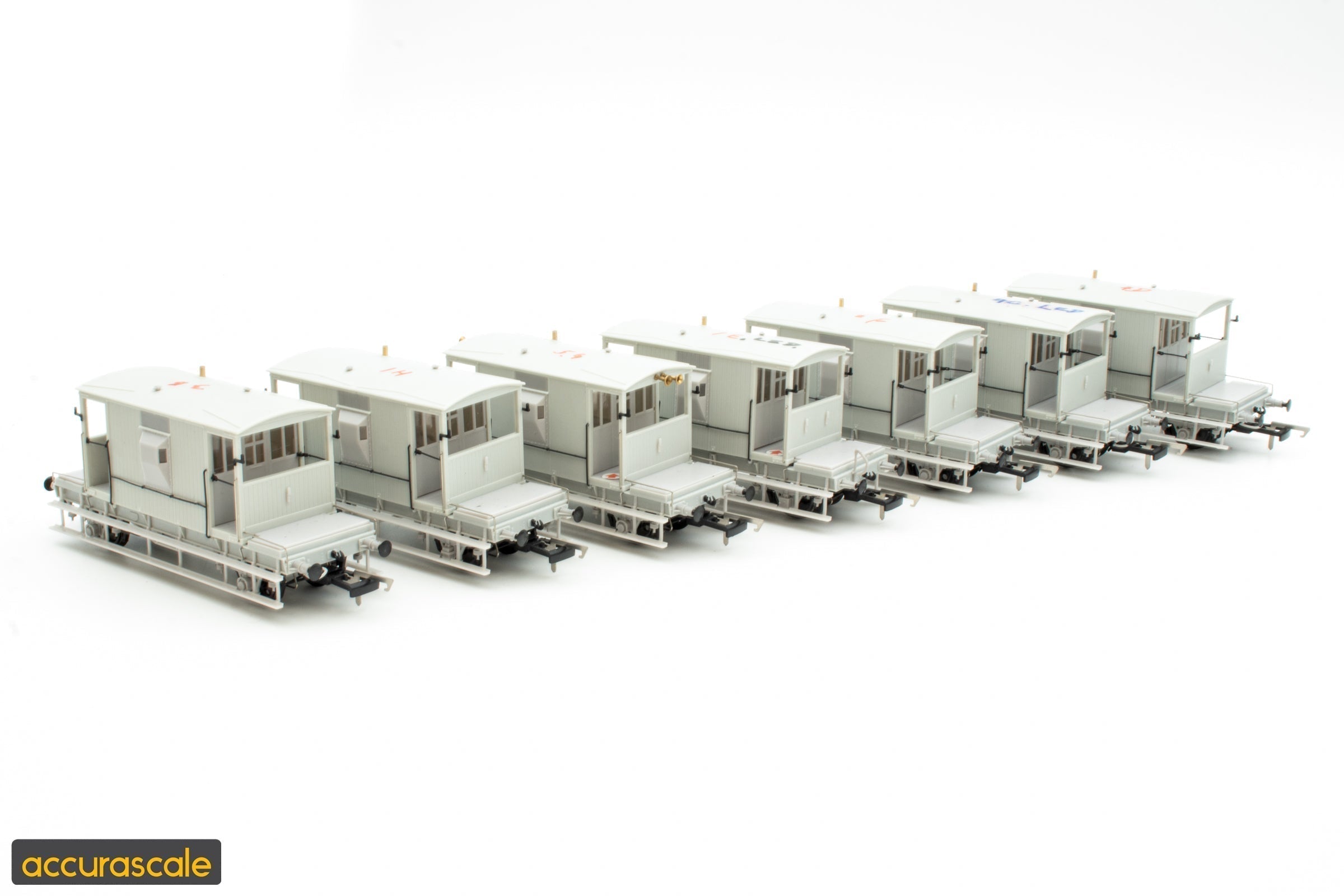
Of the millions of wagons that ran on British Railways, almost all shared one thing: the requirement for a brake van to be coupled to the rear of the train.
Indeed, you could say the same about our range. Lots and lots of wagons — but no brake vans.
Until now!
Presenting the ultimate BR standard 20-ton van and its main constituents, from Accurascale.
(TLDR? - Check out our launch video below!)
History
At nationalisation, British Railways inherited a vast number of brake vans from the “Big Four” companies, along with many even older examples from the pre-grouping era, as well as its own designs. Inevitably, standardisation became the logical solution.
Initially, BR continued building batches of LMS, GWR and LNER designs, but eventually settled on its own standard type based on the LNER design known as the Toad D. This featured a 16-foot body mounted on a 16-foot wheelbase chassis, measuring 24 feet over headstocks. Several changes were made to the original design, most visibly the addition of lengthened footboards and ballast weights mounted on the chassis ends. This became the first BR standard brake van diagram: the 1/500.

As production continued, the design evolved further. Some LNER features were removed, such as the short lower handrails used to access the veranda, and new handrails were added along the length of the ballast weights. Most production lots were split between hand-brake-only vans and those fitted with vacuum pipes, brake control valves and gauges in the cabin. These became diagrams 1/504 and 1/506, with the majority of BR-built brake vans falling under diagram 1/506.
Naturally, variations occurred between batches and construction sites. Buffers and axleboxes differed, as did rainstrips and bodyside planking. Some vans were vacuum fitted, others merely vacuum piped. The final diagram, 1/507, incorporated all previous changes. In total, 4,922 brake vans of the ex-LNER and BR standard design were produced between 1949 and 1962.
Given the large numbers and long service lives of these vehicles, it is inevitable that their liveries varied widely, from standard finishes to unique one-off examples often carrying specific working instructions on the cabin sides. Early on, a general pattern emerged: hand-brake-only vans were painted grey, while those fitted with vacuum pipes or vacuum brakes were painted bauxite, in common with the rest of the wagon fleet. When bauxite-painted vans were fitted with air pipes, the ends were painted yellow and a yellow stripe was added around the duckets to highlight the change.

The first major repaint programme occurred in the mid-1980s with the introduction of the Railfreight livery. Air-piped vans were repainted with grey bodysides and Rail Red tops to match the rest of the wagon fleet. Although this removed the need for yellow warning panels, some vans still received them. This livery was short-lived, as in 1989 the dark grey Railfreight scheme with sub-sector logos was introduced. A small number of vans survived into the privatisation era, carrying liveries such as Mainline blue, Loadhaul and even EWS.
The nature of brake-van work led to extensive variation within each diagram. Early vans were fitted with vacuum pipes, while later examples received different buffers, couplings and axleboxes. Many were fitted with air-brake pipework so that guards could ride on fully air-braked trains. By the 1970s, and with the introduction of TOPS, almost no two vehicles were identical.
Under TOPS, brake vans were given new classification codes rather than the simpler “20T” designation previously painted above the number:
- CAO – Hand brake only
- CAP – Vacuum piped
- CAR – Vacuum and air piped
- CAV – Vacuum braked
As the need for brake vans declined once guards were permitted to ride in locomotives, many were transferred into the departmental fleet. These received different TOPS codes:
- ZTO – Hand brake only
- ZTP – Vacuum piped
- ZTR – Vacuum and air piped
- ZTV – Vacuum braked
Departmental brake vans could be found in almost any yard across the network, serving as brake vans for ageing engineering stock and also as mess vans for maintenance crews.

Those that remained in the main fleet were used on duties requiring a guard to ride separately from the locomotive. These included MGR trains, nuclear flask traffic and chemical workings. A good example was the Denby branch, where a brake van was marshalled at both the front and rear of each MGR train. The rider in the leading van opened the level-crossing gates, the train passed through, and the rider in the rear van then closed the gates. The sight of a steam-era brake van sandwiched between a modern Type 5 diesel and air-braked coal hoppers was strikingly incongruous.
Not all brake vans of this design worked on the national network. Some were sold into industry, while others were built new for private users, including two for the Longmoor Military Railway and six for London Transport engineering trains. These London Transport vans were later converted into coupling adaptor wagons and survived into the 2000s, although they had fallen out of regular use during the 1990s.
The Model

The depth of the tooling suite for our BR 20t brake van means we can replicate many of the changes the prototype underwent and can reproduce some brake vans accurately for the first time in 4mm scale Ready-To-Run (RTR). Our tooling allows us to model the majority of brake vans from those as constructed right through to the final builds, along with many later — and in some cases unique — modifications, allowing you to buy the brake van that is perfect to complete your train or grace your siding.

Weighing in at just under 50 grams, thanks to its diecast floor and plastic superstructure, our brake van has all the underbody detail you have come to expect from us. Not only does it run well, it looks the part too.

We can cater for three different types of axlebox — plain (x2) or roller — and four braking systems: handbrake, fitted, vacuum piped or dual piped. There are also multiple buffer types, variations in body planking or replanking, plated ends, rainstrips and many smaller details.

It’s not just the tooling that is breaking new ground with our new model. For the first time in a model brake van, we have fitted track-powered working interior lights. There is a small LED in the roof of the cabin to represent the glow of a guard’s lantern hanging from the roof, and for extra effect a glowing red LED inside the stove gives off a warming glow that can be seen through the windows. To cap it off, we have included a small stay-alive in the circuit to ensure the lights remain flicker-free while running on your layout.

We have also included, with all models, a complement of non-functional but decorated tail and side lamps, which you can fit over the separately fitted lamp irons to fully detail your model to your own specification.
So, how much is all this awesomeness? Well, the vans will be sold in single packs for £39.95 per model, with 10% off if you buy two, three or four, and 15% if you order five or more! Delivery is estimated at Q1 2027 and they are available direct from the Accurascale website only.
Pre-order yours today via the link below!


